
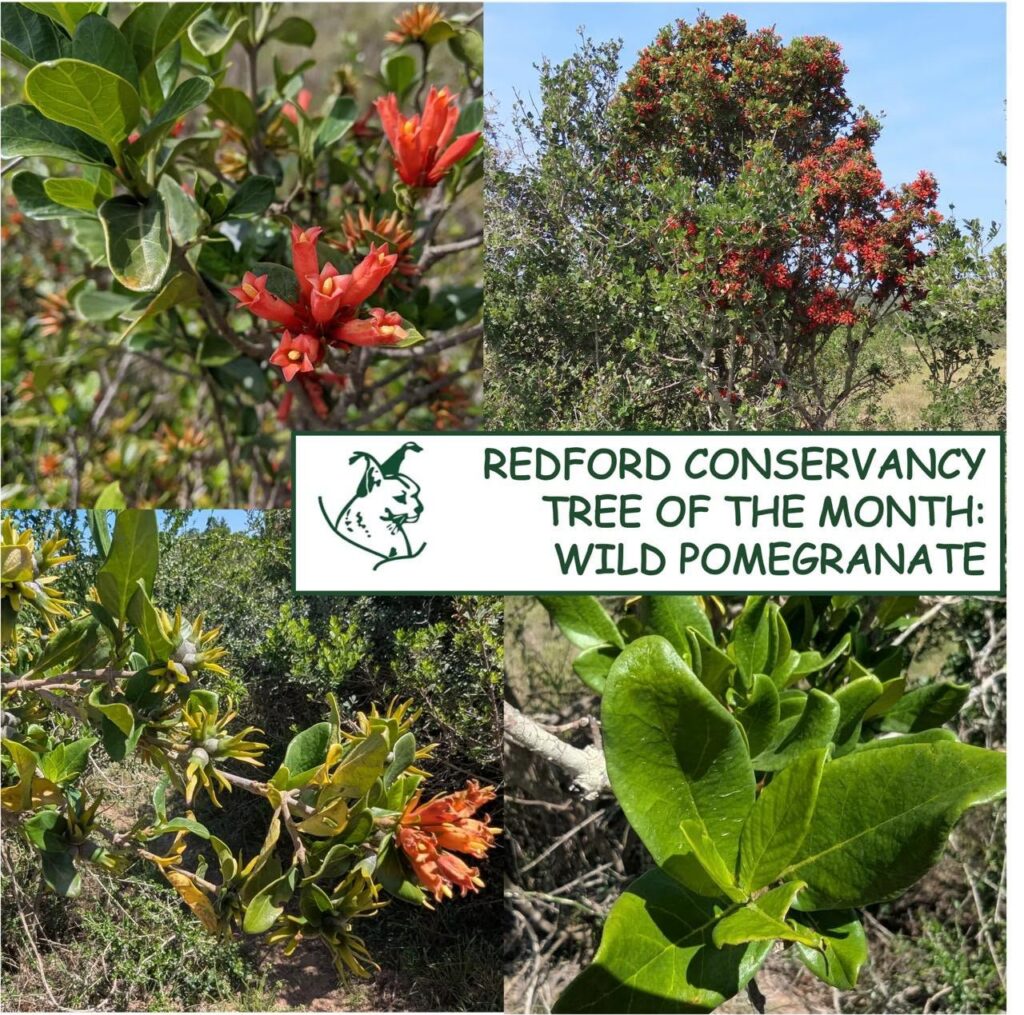
Have you seen this tree in flower anywhere? The wild pomegranate is a charming evergreen small tree with a dense, rounded form. Its dark green, glossy leaves are a lovely backdrop for the star attraction: vibrant clusters of orange-red tubular flowers, appearing in profusion right now, in spring.
What it looks like
- Striking clusters of tubular, orange-red to scarlet flowers, usually at the ends of the branches.
- The flowers have a waxy texture and are slightly swollen at the base.
- The leaves are glossy dark green above, paler and somewhat velvety underneath, and usually opposite.
- The fruit looks like tiny, hard pomegranates. Don’t try to eat them: they are inedible, although not toxic.
- No thorns.
In the garden
- A moderately deep, fibrous root system makes it hardy and adaptable. It thrives in full sun to partial shade.
- A great decorative tree for gardens, and it can be used as a hedge or screen.
- The nectar-rich flowers are a main food source for sunbirds, which are its key pollinators. Bees and other insects visit too.
- The dense foliage gives small birds excellent nesting sites and shelter, and some animals eat the fruit, which helps spread the seed.
- The wood has traditionally been used for small implements, carving and firewood.
The name
The species name bubalina comes from bubalus, Latin for buffalo, supposedly because the fruit looks a little like tiny buffalo horns: hence the Afrikaans name Buffelhoring, “buffalo horn”.
Reference: African Legacy: Burchellia bubalina