
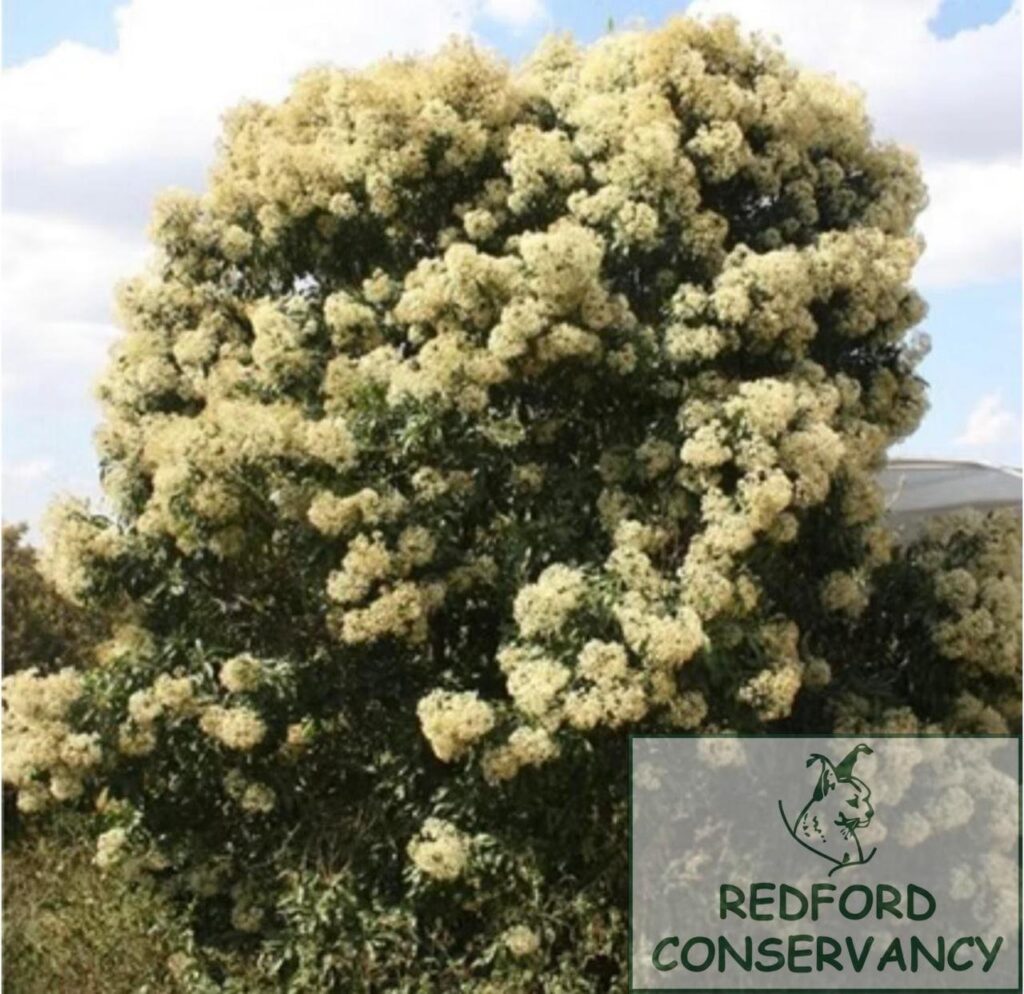
The forest elders are particularly magnificent this year: the storms must have woken them up! The profuse nectar from the flowers acts as a magnet for butterflies, bees and other pollinators, which in turn bring a variety of small birds to your garden. They grow fast and the root system is not aggressive, so consider planting one in your garden or indigenous project. Look out for it along the N2 as you head into Plett, and of course in the Nature’s Valley forests.
What it looks like
- An attractive, moisture-loving, free-flowering tree with a lovely dense, rounded crown.
- The flowers are creamy white and sweetly scented: very small, and grouped in large branched bunches. The main flowering season is winter.
- The leaves usually grow in whorls of three around the stem.
- A medium-sized tree, usually 3 to 10 m tall, but in our local forests it can reach 25 m.
Interesting facts
- It is known as one of the best bee trees in South Africa, producing so much nectar that the flowers literally buzz with activity in winter.
- The honey is light-coloured and highly regarded.
- Despite the name, it is not related to the European elderberry used for cordials and wine.
- Its rapid growth makes it useful for quickly establishing green cover.
Where it grows
- From the Southern and Eastern Cape through KwaZulu-Natal, Mpumalanga and Limpopo to Mozambique and eastern and central tropical Africa.
- In evergreen forest (especially margins and clearings), along stream banks, in wooded kloofs, in the coastal and mountain forest belt, and on rocky hillsides where there is moisture. It is fairly sensitive to frost and drought.
Growing tips
- Easily grown from fresh seed sown in spring or autumn. Treat the seed with smoke extract for better germination. Seedlings grow quickly.
- Can also be grown from semi-hardwood cuttings taken in summer.
- Prefers moist, well-drained soil with plenty of compost.
- Water regularly, especially in dry spells and while the tree is establishing: it doesn’t like to dry out completely.
- Plant in sun for the best flowering, although it tolerates some shade. It often reaches 3 to 4 m within a few years.
Uses
- The hard wood is good for small furniture, turnery, spoons and tool handles, and makes good firewood.
- An excellent tree for bees and other insects in winter, when other food is scarce. The insects in turn attract birds such as flycatchers, orioles and sunbirds.
- Used as a pioneer plant to help forests regenerate.
- Traditionally, the roots and bark are used for respiratory and digestive ailments.