
The Redford and Southern Crags conservancies combined this year to host three fun and informative outings, with many more in the pipeline.
Tenikwa
Picture this scene: a world-weary city dweller longing for a fresh, clean, idyllic life in the country falls in love with a wild and beautiful piece of fynbos and forest in The Crags. She delights in all aspects of this natural paradise: the distant barking of baboons, the delicate bushbuck and scary wild pigs are all an exciting part of her imagined new life. The property is bought, a house built and… whoa! The baboons raid the rubbish bins and the vegetable patch, the bushbuck nibble all the newly planted trees, and the bushpigs have a party digging up and gobbling all the spring bulbs. A caracal attacks her cat! And worst of all, a slender and elegant boomslang slides from the forest in through the bedroom window. What to do?
Hopefully this is where her friendly conservancy can lend a hand with some suggestions, so that she doesn’t yell: “Shoot the baboons! Trap that caracal! Chop up the snakes! Cut down the fynbos and forest! Security-fence the entire property! Buy large and fierce dogs!” Something not completely unfamiliar, I think.
A big concern of the conservancies is the increasing pressure on wildlife in The Crags from trapping and snares, and from habitat loss as more people move into the area. New houses are built with fences and dogs that affect the movement of wild animals, and grape farming is replacing indigenous fynbos, creating a ‘green desert’ as far as wildlife is concerned.
To shed some light on the problem we asked Tenikwa to share their knowledge of the threats facing wildlife in The Crags and their suggested solutions. Mandy and Len generously invited us all for a walk around Tenikwa’s wildlife rehabilitation sanctuary, followed by an in-depth discussion. They demonstrated the problem with a rescued wild bush piglet, and their point went straight to our hearts.
The conservancies are aiming to draw up a map of wildlife movement in The Crags, with a view to establishing corridors of safety that would allow our wild animals to grace the area for a little longer, before the bushbuck, bushpig, monkeys, baboons and caracal are pushed out by human pressure, as the duiker, elephants, buffalo, rhino and hippo were by previous generations.
Seaweed at Nature’s Valley
On a lighter note, the popular local biologist and naturalist Connie Smits persuaded some of us that the seaweed in our coastal rock pools is a misunderstood and neglected part of our floral heritage. The result was a fantastic spring low-tide outing to Nature’s Valley.
We started with a walk from the top of the Nature’s Valley pass down to the Salt River mouth and across to the beach, where we met the non-walkers. Under Connie’s guiding eye we collected very small samples of the different seaweeds exposed by the spring low tide; the variety of colours, shapes and forms was amazing. Unfortunately a series of octopus encounters stole the show. A particularly hungry and vividly coloured octopus attached itself to Clive Noble’s foot, but, finding it rather tasteless, transferred its attentions to a crab, which it fiercely attacked and devoured. Then it crept away across the rocks and disappeared into the seaweed. Better than the Discovery Channel!
Afterwards we walked down to Phil Martin Park for ‘show and tell’ with Connie, and an intriguing talk on the marvels of seaweed, which is far more important to life as we know it than any of us had imagined.
The fossilised elephant tooth
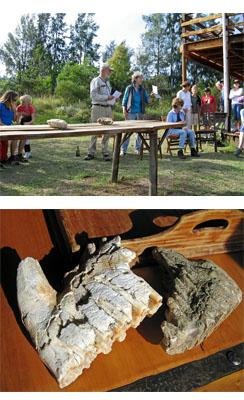
Our third outing followed the origins of an elephant tooth recently found in the Duiwelsgat River, and the thought of elephants roaming around The Crags put stars in our eyes. Pru, Rich, Drew and I headed up an expedition from Duiwelsgat down to the Keurbooms River, hoping to pick up an old elephant trail. After several hours of bundu-bashing, wading and swimming through (at times) grey, green and grimy water, we began to have doubts about the terrain being suitable for elephants. But our imaginations were fired up, and Janet had the great idea of inviting an expert to look at the tooth and the place it came from.
Other members were just as fascinated, so everyone was invited to join us in taking palaeontologist Chris Gow down to the Duiwelsgat. After a fun hike to this most beautiful of rivers, we all went back to Pru’s house, sat in the winter sunshine and listened to Chris’s talk, followed by an increasingly enthusiastic debate with some local experts, with fantastic knowledge emerging from our very midst. Then came a lazy lunch that lasted all afternoon. It’s tough to be a conservancy member!
Written by Jane Luck. First published in the Redford Conservancy newsletter, August 2010.